Back to Guide
Family Trip With Parents: How to Plan for Everyone
LN Tourism PublicationNovember 9, 2026 8 min read
Facts checked on 9 November 2026 by LN Tourism Publications
A Delhi-Agra-Jaipur family route can work at two very different speeds. Compare shared time, room access, rest and transport before asking for a quote.
Family Trip With Parents: How to Plan for Everyone
A family trip with parents works best when you agree on the pace before you agree on the attractions. Ask each traveller what they want to enjoy, check the hotel and vehicle against their actual needs, and leave room for one person to rest while others go out. The route can stay the same. The way you use each day changes.
Here is the question worth asking before anyone sends a hotel link to the group chat: what would make the trip pleasant for each person at the end of a long day?
A child might remember a courtyard and an unhurried snack. A parent might want the Taj Mahal. Another family member may simply want everyone at dinner without arriving tired and irritable.

Why does everyone say yes to a different trip?
The easiest mistake is to ask only where the family wants to go. Ask how they want to spend a day. Each person can pick one thing they would hate to miss, one thing they would happily skip, and one point at which they would want to return to the hotel. That short conversation is more useful than a list of twenty attractions.
There is a current reason to take shared time seriously. In a YouGov survey commissioned by Airbnb and published on 5 November 2026, 63% of 2,012 urban Indian respondents aged 18-45 said they most enjoyed relaxing together at the accommodation on intergenerational trips; 56% selected sightseeing. Airbnb also reported more than 55% year-on-year growth in domestic stay searches on its platform for groups of at least five including a child or infant.
The practical lesson is smaller than the headline. The stay and the gaps between activities are part of the holiday. If everybody has energy for one shared experience and a meal, that can be a successful day.
How can the same Delhi-Agra-Jaipur route feel so different?
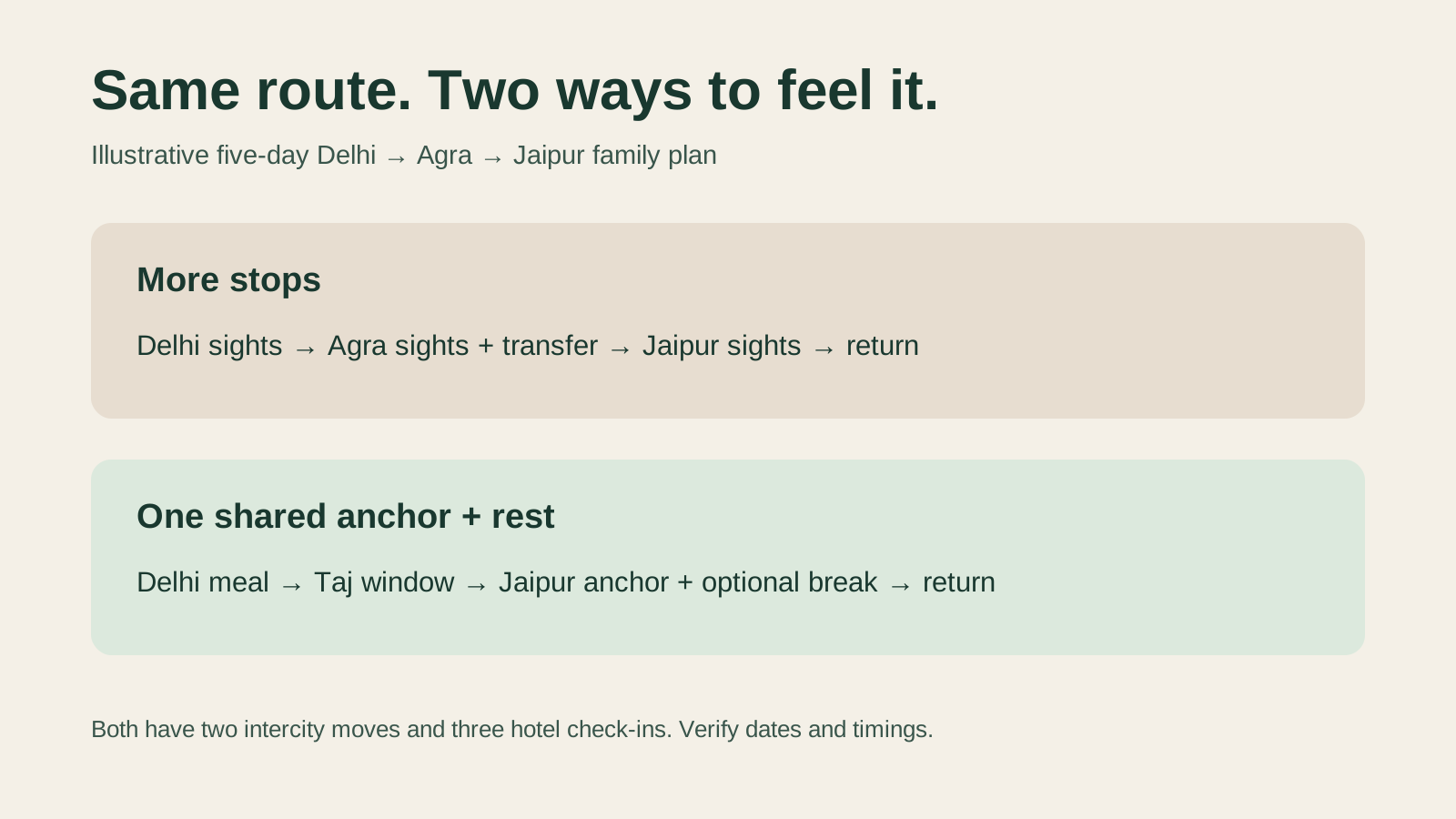
Consider five calendar days on the Delhi-Agra-Jaipur circuit, with the first night in Delhi, the second in Agra and the last two in Jaipur. That means two intercity moves and three hotel check-ins whichever version you choose. Arrival and departure times can reduce usable sightseeing hours further. The exact transfer times and monument hours need checking against the family’s dates and pickup point; the plans below are examples, not a booking promise.
Version A: fit every stop into the five days
The family lands, checks in and goes straight out in Delhi. The next morning starts early, with a city stop before the drive to Agra. Taj Mahal tickets and another monument are planned for the following day, then the car continues to Jaipur. Jaipur gets a major fort, a second sight and market time before the return journey. It sounds efficient on paper. In practice, the child and the parent who wants fewer stairs have to match the pace set by the longest day. Lunch slips later, hotel check-in becomes another task, and everyone reaches dinner with less to say.
Version B: protect one shared moment each day
Keep the same nights and city order, but choose one main shared outing per day. Arrival day in Delhi is for check-in and a meal close to the hotel. Before Agra, leave the morning clear enough for breakfast and departure without a rushed attraction. Give the Taj Mahal a proper window on a day it is open; make a second Agra stop optional. In Jaipur, agree on one anchor visit, then let part of the group return to the hotel while others explore. Meet again for dinner at a time everyone can manage. The last day protects the return transfer instead of squeezing in one last ticketed stop.
Version B does not remove the intercity drives or make every property suitable. It spends less of the family’s energy on queues, repacking and another attraction. If two moves in five days still feel heavy, add a night or drop a city.
For a closer test of whether five calendar days fit at all, read LN Tourism’s separate https://www.lntourism.com/blog/golden-triangle-tour-package guide, which focuses on arrival, Friday and return timing.
What changes when you choose the hotel before the attractions?
A hotel is not just a place to sleep on a family trip. It determines whether five people can meet easily, whether someone can return for a break, and whether a late arrival turns into a tiring climb. Ask for the exact room configuration, the number of beds, whether rooms can be near each other, and whether there is a usable shared place to sit or eat. If adjoining or connecting rooms matter, ask whether the exact arrangement is confirmed rather than merely requested.
Check the route from vehicle drop-off to reception and from reception to the room. “Has a lift” does not tell you whether there are steps before the lift, whether the booked room is in another block, or whether the bathroom fits an individual traveller’s needs. Ask for recent room and access photos if those details matter. The right question is specific: “Can this traveller reach the booked room without stairs?” A property should confirm that in writing.
LN’s hotel policy says hotel names discussed at enquiry stage can be indicative and the confirmed selection is communicated in the quotation or booking confirmation. That makes room layout and access questions part of the written quote, not something to assume from a category label. Policy: https://www.lntourism.com/hotel-policy
A shared dining area deserves the same scrutiny. Does the family want breakfast together before a drive? Can one person eat at the hotel while others return later? Is there somewhere to sit beyond the bed? Those details may do more for the trip than upgrading a monument ticket.
Can one person skip a sight without splitting the holiday?
Yes, if the meeting point and transport are planned before the group separates. Say the group’s Jaipur anchor is a fort. One parent may choose a shorter visit or no visit that day; the child and adults may want longer. Agree on where the vehicle will wait, who travels back with the resting person, and when the group meets again. If the quoted vehicle cannot make a separate return trip without leaving the others stranded, the “optional” activity is not truly optional.
Do not write “private cab” and assume the driver can stay on call for unlimited extra journeys. Ask about duty hours, route limits, parking, waiting time and extra kilometres in the actual quote. A guide, if included, also needs a defined scope. A good split plan names who accompanies the child and avoids making one older traveller wait outside a gate as an afterthought.
At the Taj Mahal, the official site says general visiting is closed every Friday. If Agra day falls on Friday, shift the city order or the Taj visit before reserving non-refundable rooms. Check the official site again for the actual dates, visiting hours and tickets: https://tajmahal.gov.in/faqs.aspx
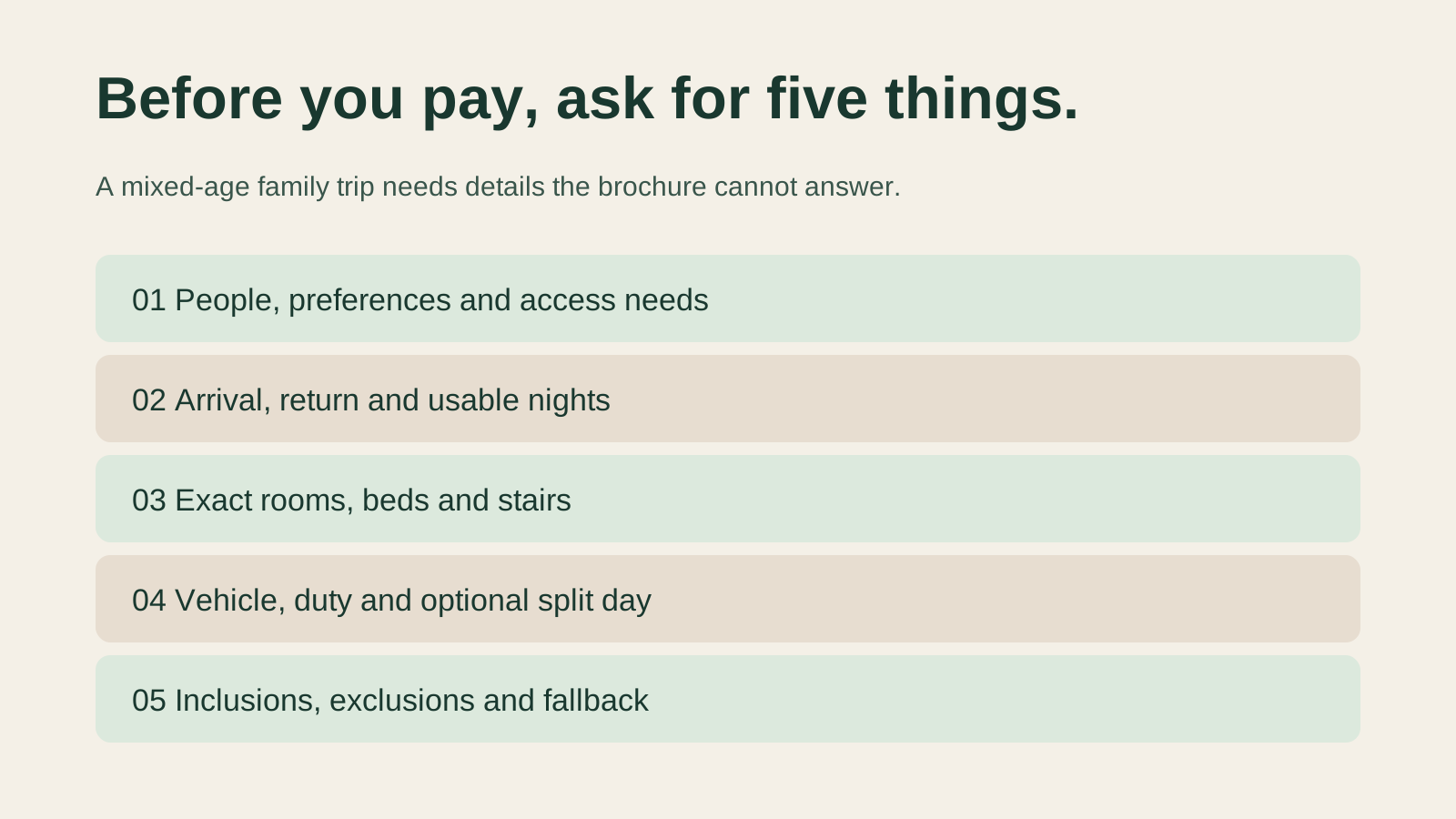
What should a family agree on before requesting a quote?
Start with people, not a package name. Give the planner the number of adults and children, the child’s age, each person’s must-do and easy-to-skip activity, and any mobility, food or rest needs they want considered. Age alone cannot tell a planner how far someone can walk. Say what the person can and wants to do, and what must be checked with a supplier.
Then give actual arrival and departure times, pickup and drop locations, usable nights, preferred hotel room arrangement and a realistic spending range. Ask what the cab quote includes: vehicle type, luggage capacity, driver duty, tolls, parking and any extra distance. Ask whether monument tickets, local guide, meals and cancellation terms are included. If you want a slower day or a separate drop-off, ask for that line in the quote.
Keep one fallback. If the Taj day collides with Friday, change the sequence. If connecting rooms cannot be confirmed, consider two nearby rooms or another property. If a chosen visit involves more walking than one traveller wants, keep a shorter shared activity and a planned return. A fallback is not a lesser trip; it is how the holiday still works when one component changes.
When is the route too much for the time you have?
The simplest test is to subtract travel before adding sights. Five calendar days do not automatically mean five days out.
Count arrival time, hotel check-in, two intercity transfers and the return journey.
If the only Taj slot is a Friday, that is another constraint.
If a family wants long meals, a midday rest and a full Jaipur day, five days may be tight.
A sixth day buys space; it does not guarantee every attraction will fit.
For this family, the better question is: “What would we still enjoy if we saw only one headline place in each city?” If that answer sounds worthwhile, the route may suit them. If the answer requires a long attraction list to justify the trip, change the duration or choose fewer cities. There is no universal “senior-friendly” itinerary; the plan has to fit the people travelling.