Back to Guide
Winter Treks in North India 2027: Choose Your Route
LN Tourism PublicationNovember 12, 2026 7 min read
Facts checked on 13 November 2026 by LN Tourism Publication
Choose a winter trek by the walk you would still enjoy if the top is out of reach. Compare four Uttarakhand routes, one conditional Himachal option and the questions to ask before paying.
Winter Treks in North India 2027: Choose Your Route
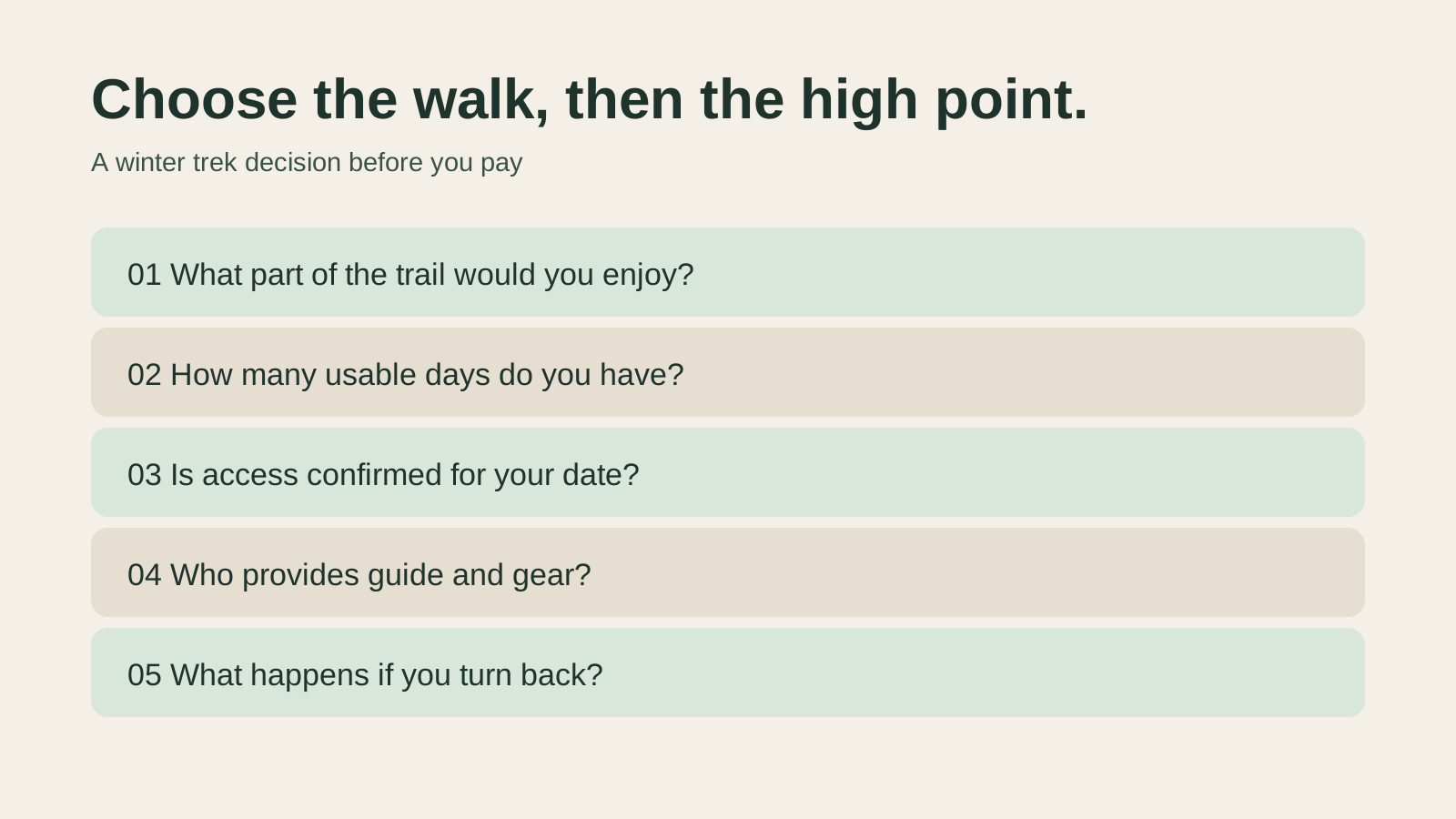
The right winter trek is one you would still be glad to have chosen if the final climb stops early. Nag Tibba offers a shorter forest-led commitment; Dayara Bugyal makes the meadow the destination; Kedarkantha asks for a summit-focused, multi-day plan; and Brahmatal offers a longer lake-and-trail journey. None comes with a guaranteed snow day, open trail or summit in January to March 2027.
Choose the experience first, then verify the route, guide and contract for your dates.
Imagine saving a summit photograph and booking the trip around that one frame. A few weeks later the trail is icy, daylight is running short or someone in the group is struggling. The sensible guide turns the group back.
Was the trip a failure?
That depends on what you thought you were buying and whether the walk before the high point appealed to you. This is an illustrative scenario, not a report of a particular trek or an operator’s promised fallback.
How much winter can your trip hold?
Count door-to-door time before comparing summit photographs. Uttarakhand Tourism describes Nag Tibba as a two-day route from the Dehradun side via Panthwari. Its published winter itineraries for Dayara Bugyal and Kedarkantha each span six days including the approach and return journey. Its Brahmatal route page gives four trekking days, before any travel to and from the Lohajung base. These are examples of route designs, not a universal package duration or a promise that your 2027 departure will follow the same camp sequence.
A traveller with one weekend should first examine the actual pickup point, road transfer and descent day for Nag Tibba. Someone with five or six usable days can consider a longer trail. “Usable” means the days left after reaching the roadhead and returning home. If the itinerary begins at dawn in Dehradun while you arrive at noon, it is not a fit until the operator rewrites it.
Effort is more than a difficulty label. Ask for daily ascent, hours on foot, pack weight, sleeping elevation, terrain, cold exposure and the longest descent. The official Nag Tibba page calls the experience easy to moderate, while the Brahmatal page places “Easy” in one field and “moderate” in its description. Treat those labels as a prompt for specific questions rather than a personal fitness assessment.
Which part of the trail would you enjoy before the top?
Nag Tibba: a short forest trek
The Uttarakhand Tourism route passes forest and the Nag Devta temple before the upper camp and summit area. That gives a shorter commitment with a recognisable trail experience even when the highest point is not reached. Its two-day format still contains a full walking and return day. Ask the operator which trail variant, campsite, guide and descent are proposed; the official page itself describes more than one way back. Do not book for a snow guarantee.
Source: https://www.uttarakhandtourism.gov.in/treks-details/Nag%20Tibba%20Trek
Dayara Bugyal: make the meadow the objective
Dayara suits someone drawn to broad open ground rather than a single peak pose. Uttarakhand Tourism describes approaches through Raithal or Barsu, with forest and meadow sections and a six-day winter example. A separate official page includes January in its broad season range, but that does not certify snow depth, road access or camping permission for a specific week in 2027. If a guide shortens the upper walk, ask what meadow or viewpoint can still be reached safely that day, without treating a particular alternative as pre-approved.
Sources: https://www.uttarakhandtourism.gov.in/treks-details/Dayara%20Bugyal%20winter%20trek; https://www.uttarakhandtourism.gov.in/treks-details/Dayara%20Bugyal
Kedarkantha: choose the climb deliberately
The official Kedarkantha winter route starts from Sankri and describes forest, Juda Lake and a separate summit attempt. Its published six-day plan includes the long approach road journey. This is the right shortlist entry for a traveller who wants to prepare for a summit day, and who can accept that weather, snow, daylight or group condition may end that attempt. Ask where the go/no-go decision is made, what time the group must turn around and how the descent changes if the summit is skipped. The answer belongs to the actual guide and route plan.
Source: https://uttarakhandtourism.gov.in/treks-details/Kedarkantha%20Winter%20Trek
Brahmatal: a longer lake-and-trail journey
The official Brahmatal page describes a four-day trek from Lohajung through forest, meadow and alpine lake country. It also contains contradictory altitude figures in its day-by-day entries. Do not copy its inconsistent heights into a packing or fitness claim. Ask the operator for the planned camps, highest sleeping point, total walking days and a route map. If an upper objective is cut, the value of the journey depends on which lower sections the group actually reaches.
Source: https://www.uttarakhandtourism.gov.in/activity-trek-details/Brahmatal
Does Triund fit a winter shortlist?
Triund gives the comparison a Himachal option: a McLeod Ganj-area ridge walk rather than a multi-day Uttarakhand summit itinerary. Himachal’s trekking portal describes the McLeodganj–Triund route, but the opening and closing dates displayed there are from 2022. They cannot establish permission for January, February or March 2027. Previous Kangra winter restrictions have also changed. Include Triund in your personal shortlist only after the current Kangra district or trekking authority confirms daytime access, any permission or guide requirement, and whether overnight camping is allowed on your dates.
Sources: https://trekking.hp.gov.in/trekdetail/55; https://hptdc.hp.gov.in/travel-tips
If that confirmation is unavailable, choose a different date or a lower activity that has been checked locally. Do not buy a “Triund winter camp” on the strength of an old portal date or a generic tour listing.
What happens when the climb stops early?
The guide’s decision should follow conditions on the day, not a photograph in the booking page. Before paying, ask who has authority to turn the group around, how weather and trail conditions are checked, how people with different paces are managed, and what the safe descent or return plan is. A turnaround is not a specific substitute itinerary promised by this article. The available route may narrow to a lower trail, a camp, a roadhead or simply a safe return.
Ask what the contract does when a summit is missed. Is the trek fee for the guided days and support delivered, or for a named objective? What happens if the approach road closes before the group starts? What happens if the operator cancels, the authority refuses access, or a traveller chooses not to continue? These are different events and may have different refund or rescheduling terms. Get the written terms for each, including any non-refundable transport or accommodation component.
This is also where equipment and emergency planning become concrete. Confirm the guide-to-group arrangement, traction equipment if conditions call for it, warm layers, accommodation and camp arrangements, communication gaps, evacuation procedure and who pays for an unplanned transfer. Follow the actual operator’s advice for your route and check official weather warnings near departure.
Uttarakhand’s IMD centre publishes state and district warnings: https://mausam.imd.gov.in/dehradun/
What should you check before paying?
Start with the operator and route, then the price. Ask for the dated itinerary, roadhead, daily walking plan, camp locations and a named local contact. Ask who provides the trekking guide, whether that person knows the route in winter, and whether the quoted trip includes permits or registrations required for your date. Ask what boots, microspikes or other equipment you must bring or rent. Do not accept “all included” without an itemised list.
Then check the travel edges: pickup city, arrival cutoff, return drop, vehicle type, luggage, extra night if snow delays the road, and the point at which the operator decides to cancel. Ask for the medical and fitness information the operator needs from you, and the emergency process. Keep the written quote and the route notes together. A cheap trek with an unclear exit plan is difficult to compare with a more expensive one that specifies guide, gear and transfer scope.
Where does LN Tourism fit?
LN’s public Chopta-Tungnath-Chandrashila package is a useful example of why the quote matters. The page treats Chandrashila as a conditional summit attempt and says a trekking guide is not in the current listed inclusions. Its existing Tungnath guide explains why the temple visit and the steeper summit section should be considered separately. That package is one verified LN connection; it does not establish that LN sells Nag Tibba, Dayara, Kedarkantha, Brahmatal or Triund.
Sources: https://www.lntourism.com/packages/chopta-tungnath-chandrashila; https://www.lntourism.com/destinations/tungnath
If Chopta is your preferred corridor, read the https://www.lntourism.com/destinations/tungnath destination guide, then ask for a date-specific https://www.lntourism.com/packages/chopta-tungnath-chandrashila quote that states guide, road, stay and equipment arrangements. For the other treks, use this article’s questions with a qualified operator whose actual route and terms you can verify.