
Back to Guide
India Tourism Growth 2026: Domestic Boom, Global Impact & What Travellers Should Know
HARSHIT JAISWALSeptember 24, 2026 7 min read
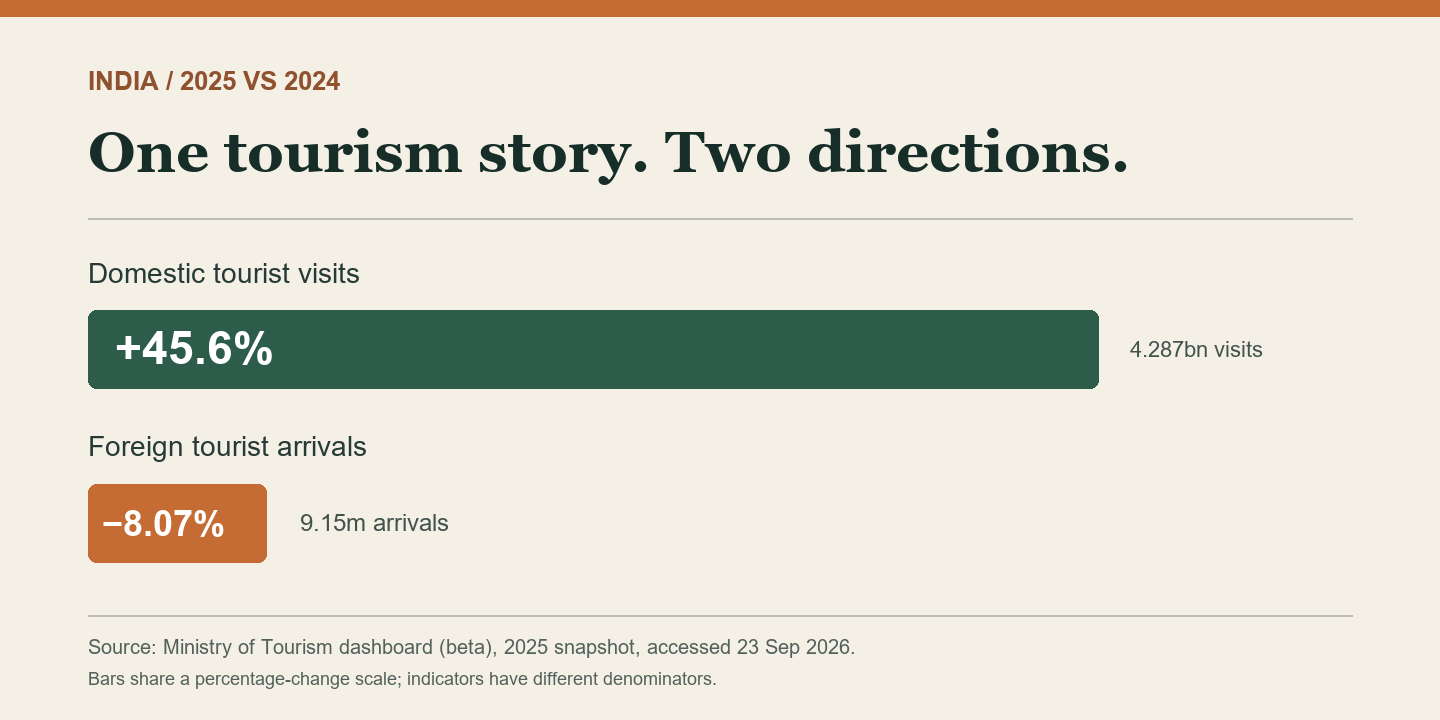
India’s Ministry of Tourism reports about 4.287 billion domestic tourist visits in 2025, up 45.6% year on year, while foreign tourist arrivals fell 8.07% to 9.15 million. Separately, the World Travel & Tourism Council (WTTC) estimates that travel and tourism contributed US$11.6 trillion to global GDP in 2025. Those are three different measures, not three ways of counting the same travellers.
The most interesting tourism headline this year is not that people are travelling again. It is that the same industry is moving in different directions at once. India recorded an extraordinary rise in domestic tourist visits in 2025, even as foreign tourist arrivals declined. Meanwhile, the global travel economy reached a new high. If you are planning a holiday - or building one for someone else - the question is less “Is tourism growing?” and more “Where is the pressure, where is the opportunity, and how do we travel well?”
The split-screen headline: more trips within India, fewer foreign arrivals
Search for the latest news on tourism sector performance and you will find plenty of big numbers. The more useful story sits between them. The government’s 2025 snapshot puts domestic tourist visits at 4,286.90 million, a 45.6% increase over 2024. In the very same snapshot, foreign tourist arrivals stand at 9.15 million, 8.07% below 2024. Globally, international tourist arrivals were up 4.9% to approximately 1.534 billion. Ministry of Tourism dashboard.
This is not a contradiction. Domestic travel and inbound foreign travel answer different questions. A long weekend pilgrimage, a family hill-station escape and a city break can lift the domestic visit count; they do not automatically increase arrivals from overseas. International travel responds to an additional set of forces-air connectivity, visas, exchange rates, perceptions and the reasons a visitor chooses one country over another. Those are possible influences, not a proven explanation for India’s 2025 decline. The available headline figures show the split; they do not, by themselves, identify its cause.
There is another trap in the chart: a visit is not necessarily a unique person. One traveller may make several visits in a year, and the domestic total is compiled from state and union-territory tourism data. Reading 4.287 billion as “4.287 billion Indians travelled” would be wrong. Reading the 45.6% rise as proof that every destination grew at the same pace would be wrong too. The dashboard is also labelled a beta version, so treat its 2025 figures as a dated snapshot and recheck them before publication or reuse. Ministry of Tourism dashboard and methodology labels.
Why the money story matters more than a record-breaking adjective
The global impact of tourism is not confined to arrivals. WTTC’s latest economic-impact estimate says travel and tourism contributed US$11.6 trillion, or 9.8% of global GDP, and supported 366 million jobs worldwide in 2025. Those are modeled economic contribution and employment estimates; they are not a tally of hotel bookings or airline tickets. WTTC also estimates that the sector grew 4.1% in 2025, faster than its estimate of 2.8% growth for the broader global economy. WTTC, 14 April 2026.
The next signal arrived in August: WTTC reported that worldwide travel-and-tourism capital investment exceeded US$1 trillion in 2025, up 8.5% from 2024. Investment is a vote on future demand, not a promise that every new project will benefit every resident or visitor. For a traveller, the practical question remains whether the destination has the capacity, services and timing to deliver a good experience. For a destination, it is whether the value generated by tourism reaches local people without exhausting the place they live in. WTTC investment release, 5 August 2026.
![Taj Mahal, Agra, photographed in 2015 by [Philip Nalangan ]](https://lntourism-assets.s3.ap-south-1.amazonaws.com/tours/1790236746079-taj-mahal-original.jpg)
Indian tourism growth has an untold second chapter
In July 2026, WTTC estimated that India’s travel-and-tourism economy generated US$263.6 billion in 2025 and supported 46.2 million jobs. Domestic visitor spending reached US$203 billion, representing roughly 86% of all tourism spending in its model; international visitor spending accounted for about 14%. That is the real asymmetry behind the headline: India has a large internal travel engine, while its international share of spending leaves room to grow. WTTC India release, 27 July 2026.
It would be easy to turn “room to grow” into a vague call for more tourists. A more useful question is: What kind of journey would make someone stay longer, explore beyond one famous stop and leave with a better understanding of the place? Jaipur’s architecture, a Himalayan temple route and a riverside city are not interchangeable products. They need different time budgets, transport choices, seasonal judgment and local context.
![Hawa Mahal, Jaipur, by [Vyacheslav Argenberg ]](https://lntourism-assets.s3.ap-south-1.amazonaws.com/tours/1790236819776-hawa-mahal-original.jpg)
That is where the “more destinations” conversation gets interesting. A photograph can make a place visible; a workable itinerary makes it visitable. The difference is often unglamorous: sensible driving legs, a hotel in the right location, enough time at a landmark and a plan that can absorb a change in weather or pace. Good tourism growth should be felt in the quality of those decisions, not only in another record on a dashboard.
The 2026 traveller’s filter: what the numbers cannot tell you
A national total cannot tell you whether a particular road is open next Friday, whether a temple town is congested on your dates or whether a family member will enjoy a long mountain drive. This matters especially for Himalayan itineraries. Treat official numbers as the backdrop; make the booking decision from live route conditions, current local guidance, realistic travel times and the people actually travelling.
Before committing to an itinerary, ask three questions:
· Where is the slowest day? The longest transfer often determines how much of the trip feels like travel and how much feels like a holiday.
· What must remain flexible? Weather, road restrictions, access arrangements and operating schedules can change. Avoid an itinerary that collapses when one leg moves.
· Who is this journey for? A photography-led trip, a family pilgrimage and a short escape may share a destination but need different pacing.
![Kedarnath, Uttarakhand, by [Surendra 1999 ]](https://lntourism-assets.s3.ap-south-1.amazonaws.com/tours/1790236950532-kedarnath-original.jpg)
Where LN Tourism’s role belongs in this story
The data is national and global. LN Tourism’s role is at the scale of the individual trip. Travellers do not book a GDP contribution; they choose dates, a route, a room, a vehicle and a pace they can actually live with. A tailored plan should turn the brief-who is going, why, from where and for how long-into a coherent journey, then make clear what is included and what still depends on confirmation.
For someone exploring the hills and pilgrimage circuit, that could mean comparing a focused Kedarnath journey with a broader Char Dham Yatra, instead of forcing both into the same calendar. These links are starting points for enquiry, not statements of live price, availability, permits or road status. Confirm those for the chosen dates before payment.
This is also the useful answer to the “more tourism” question. A responsible travel company can help customers make informed trade-offs: a quieter window versus a tighter schedule; a shorter route versus more stops; a private vehicle versus a different group configuration. The promise should be clarity and fit, not a claim that any operator can control traffic, weather or the wider economy.
What to watch after this headline
First, watch whether the government’s 2025 domestic and foreign-arrival figures are revised as the beta dashboard matures. Second, distinguish new 2026 forecasts from outcomes. WTTC projected India’s tourism GDP contribution at US$286.1 billion and 48.1 million jobs supported for 2026, but those figures are forecasts made in July, not achieved results. Third, pay attention to destination-level information before you travel: national momentum is not a substitute for a current local check. Ministry of Tourism dashboard · WTTC India release
The headline worth remembering is simple: India’s travel story is big, but it is not one-size-fits-all. Domestic visits surged, inbound foreign arrivals softened and the world’s travel economy expanded. For your own holiday, the smartest response is neither to chase a trend nor avoid it. It is to make the route, season and pace make sense for you.
Planning an India journey? Explore LN Tourism’s Kedarnath or Char Dham itineraries, or message the team on WhatsApp with your dates, group size and starting city. Travel that stays with you.


