Back to Guide
Meteor Shower in India 2026: When to See the Geminids
LN Tourism PublicationOctober 29, 2026 7 min read
Facts checked on 29 October 2026 by LN Tourism Publications
The IMO predicts the 2026 Geminids maximum for 14 December at 7:30 p.m. IST. Plan a safe, dark viewing site and keep a weather fallback; the predicted peak does not guarantee a clear sky or a sighting.
The Geminid meteor shower is the December night worth planning around in India.
The International Meteor Organization (IMO) predicts its 2026 maximum for 14 December at 14:00 UTC, or 7:30 p.m. IST. Set aside the night of 14-15 December if you can, and keep the pre-dawn hours of 14 December as another useful window.
A clear, dark and safely accessible sky matters more than arriving at an exact minute. Source: https://www.imo.net/files/meteor-shower/cal2026.pdf
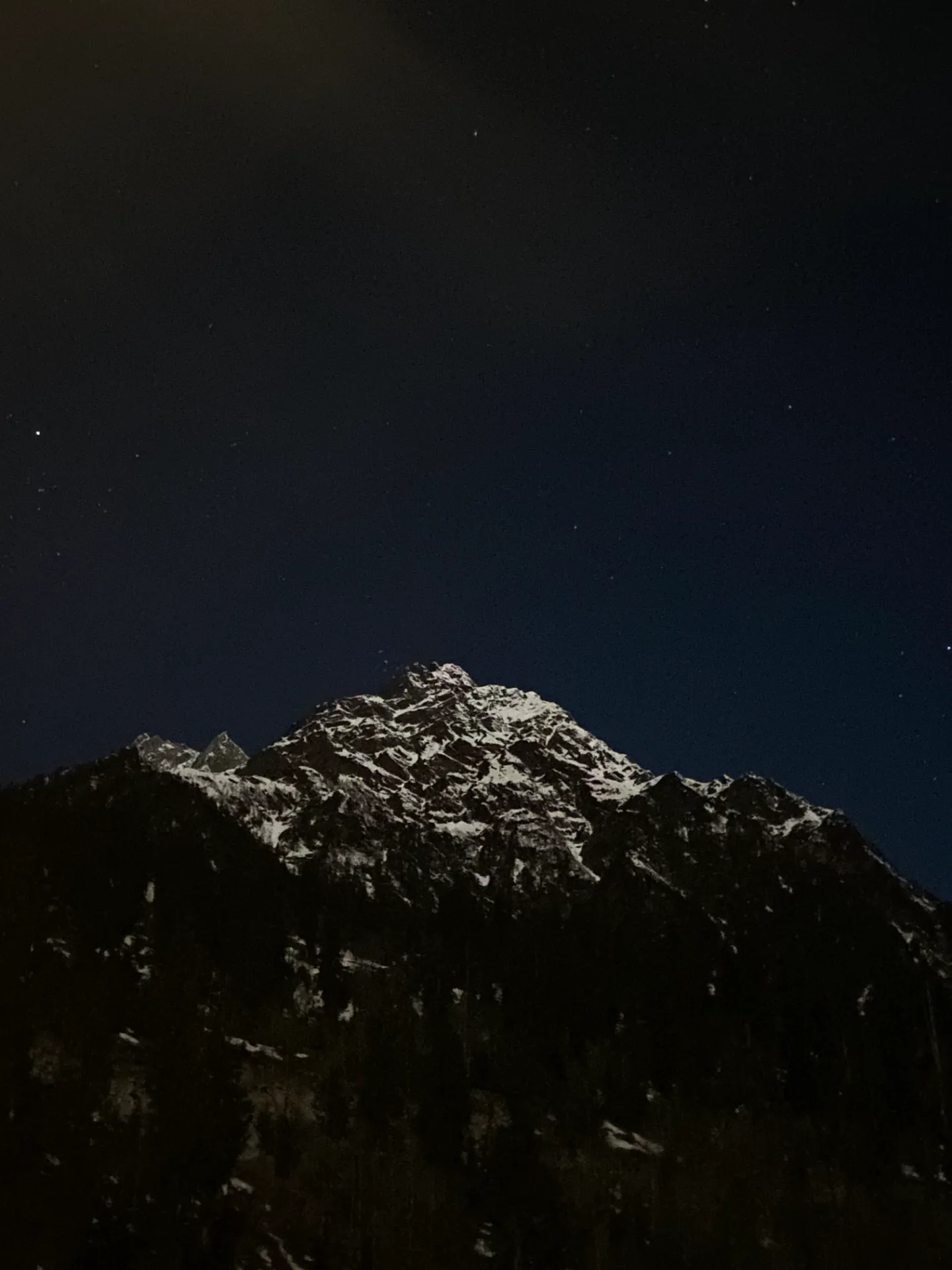
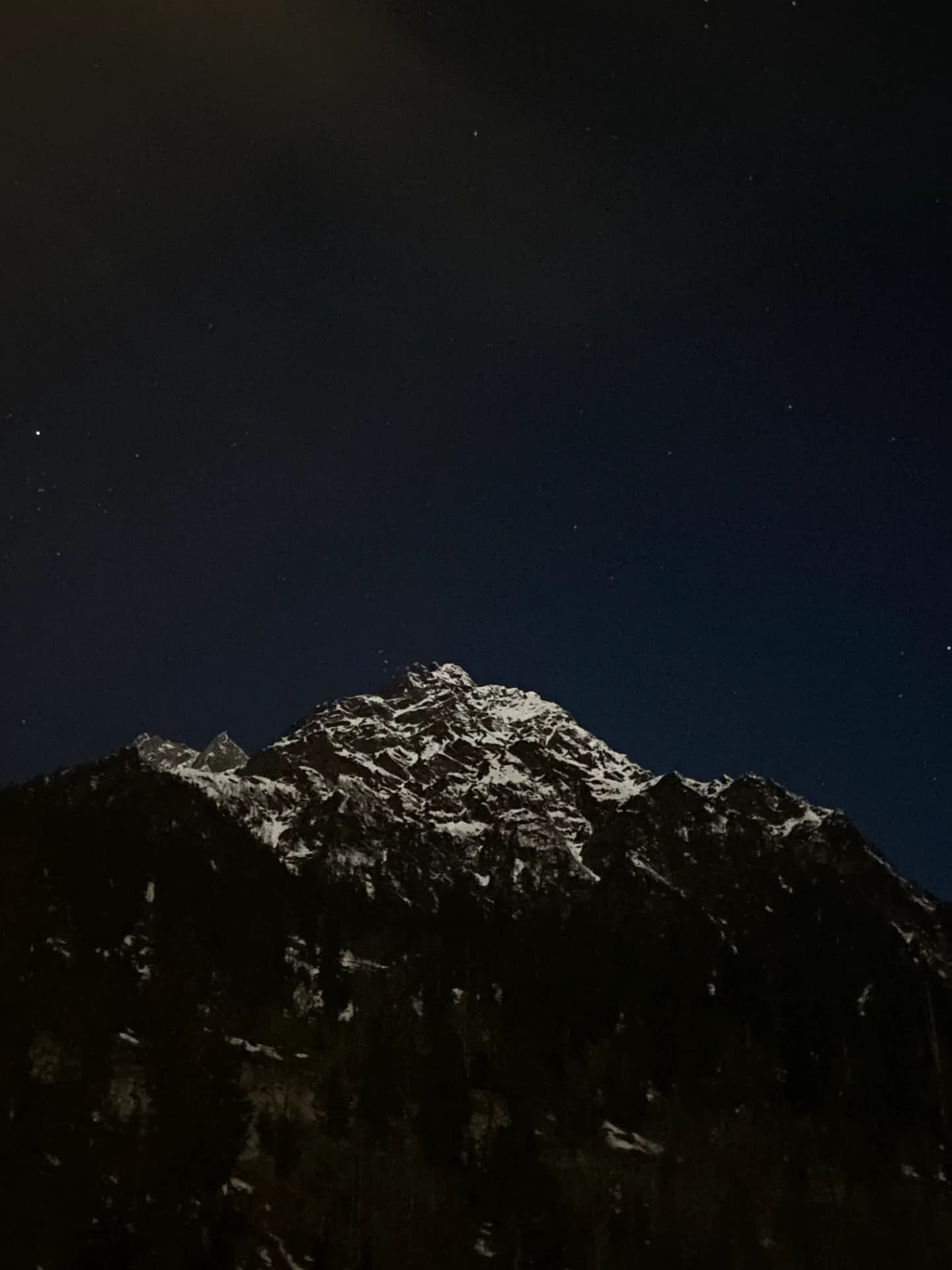
Real night sky photographed near Manali in March 2022
Why does the date look different on different calendars ?
You may have seen “13-14 December” in a global Geminids calendar. That is a useful reminder, but it is not an India-specific appointment. The IMO’s detailed 2026 calendar gives a predicted maximum on 14 December at 14:00 UTC. Adding five hours and 30 minutes puts it at 7:30 p.m. IST on the same day. It also describes a broad peak, with historically observed maximum timings spanning roughly 14 December from 2:30 a.m. to 11:30 p.m. IST when converted from its UTC range. Those hours describe uncertainty and broad activity, not a guaranteed burst at every location. Source: https://www.imo.net/files/meteor-shower/cal2026.pdf
A practical plan is therefore to watch on the evening of Monday 14 December and, if your schedule permits, continue into the early hours of Tuesday 15 December. If a forecast later favours the previous night, pre-dawn Monday 14 December is still within the wider peak period. Do not buy a rigid single-night trip solely because a graphic says “peak at 7:30.” The shower does not switch on and off at that time.
What makes a place worth travelling to for one night?
Start with the sky you can actually use. A famous hill town can be bright around hotels, roads and markets. A quiet stay may have a floodlit courtyard or a ridge that hides half the sky. Neither its altitude nor its reputation tells you whether you can stand outside after dark and see a wide field of sky safely.
Ask a stay or local host four plain questions before paying:
Can guests use an outdoor viewing area through the late evening or overnight? Which lamps remain on, and can the viewing spot avoid direct glare?
Is the horizon reasonably open, rather than blocked by trees or buildings?
How do guests return indoors safely without walking a dark road or entering restricted land?
Written answers beat a beautiful night photograph.
There is a second filter: the forecast. A dark site under thick cloud is a poor viewing site. Look at the specific town or coordinates shortly before departure, and keep a flexible plan. Weather predictions made weeks ahead cannot confirm your December sky.
The India Meteorological Department’s forecast and any current local advisories should be checked near the date: https://mausam.imd.gov.in/.
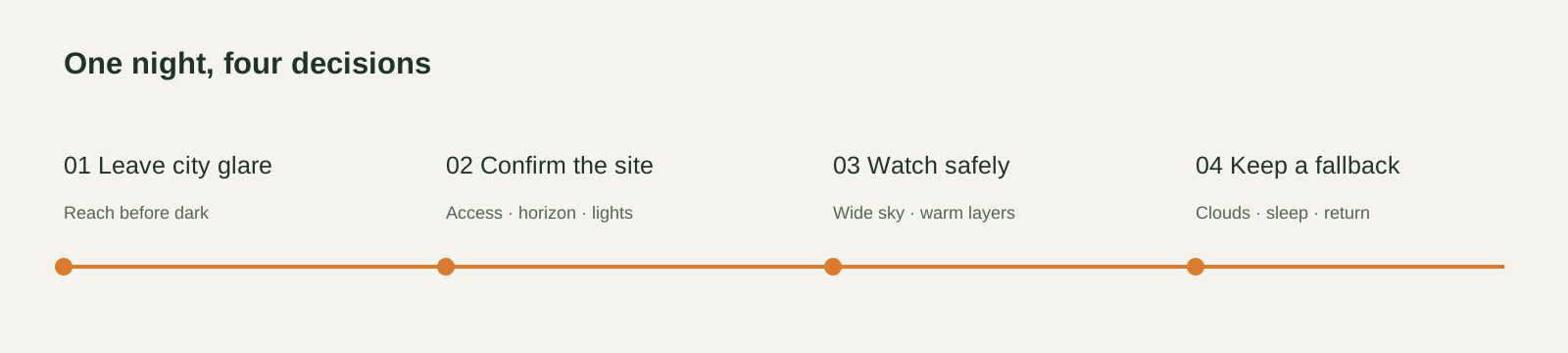
Four simple stages: city glow, confirmed dark arrival, safe skywatch, morning or cloud fallback.
Where can you begin the search in India?
For a one-night meteor trip, begin close enough that you can arrive in daylight and still enjoy the next day. The choice is between a verified viewing spot near your city and a farther stay whose darkness and access you have checked. A long drive to a famous remote destination may consume the evening you meant to spend outside.
From Dehradun, the Mussoorie-Dhanaulti corridor is a plausible short-break search area because LN Tourism lists a Dehradun-to-Dhanaulti cab route. That listing confirms a transport route; it does not certify a dark-sky viewing site, open terrace, overnight access or December conditions. If you explore that option, select the exact stay and viewing position first, then ask for a transfer that reaches it before dark. LN route page: https://www.lntourism.com/services/cab-transport/dehradun-to-dhanaulti-cab
From elsewhere in India, apply the same test to a reachable area rather than copying a “best stargazing places in India” list.
Check a candidate’s actual night lighting, host permission, horizon, forecast, winter access and return plan.
Light-pollution maps can help screen areas, but a map colour is an estimate of sky brightness, not proof of the view from a terrace.
A site visit, recent unedited night view or a credible host answer is more useful.
Choose the place for the person travelling too.
A family with children may prefer an accessible property where they can step indoors after an hour.
Friends who intend to stay out late need a clear transport and sleep plan.
A couple wanting a relaxed escape may be happier with two nights so cloud on one evening does not define the trip.
These are editorial choices, not claims that any particular property guarantees a sighting.
What should you expect when you finally look up?
You do not need a telescope. Meteors cross broad parts of the sky, so a telescope’s narrow view is the wrong tool for the main event. NASA recommends getting away from city and street lights, lying back, taking in a wide sky and allowing about 30 minutes for eyes to adjust. Wear warm layers and bring a reclining chair or mat, a blanket and a light that will not keep dazzling your group. Source: https://science.nasa.gov/solar-system/meteors-meteorites/geminids/
Give the night time. A photograph may stack many trails or use a long exposure; your eyes will see individual quick streaks, with pauses between them. The IMO’s high “zenithal hourly rate” describes an idealized observing measure and should not be sold as how many meteors every traveller will personally count. Actual viewing depends on darkness, cloud, the Moon, sky coverage and patience. The IMO expects favourable moonlight conditions near the 2026 peak, but that still cannot clear your local clouds. Source: https://www.imo.net/files/meteor-shower/cal2026.pdf
The story of the shower is unusual enough without inflating it. NASA identifies its source as 3200 Phaethon, an asteroid or possible “rock comet”; its debris meets Earth’s atmosphere and appears as the Geminids. The apparent point of origin is in Gemini, but you can watch a broad open sky. Source: https://science.nasa.gov/solar-system/meteors-meteorites/geminids/
How would one realistic night unfold?
Treat this as a sample plan, not a booked LN itinerary. Arrive in daylight on 14 December so you can inspect the viewing area, find the path back to your room and eat before you settle in. Check the live cloud forecast after arrival. If conditions work, begin after dark, allow your eyes to adjust and watch in comfortable blocks rather than demanding a fixed number of meteors. A broad shower gives you time to pause and warm up.
If you are travelling from a city, reserve the following morning for sleep and the return journey. Driving out immediately after an all-night watch is a poor trade. If winter roads or local rules make the chosen site impractical, use the nearer safe option or postpone. The night should be enjoyable without forcing a risky trip.
What if clouds arrive or you see nothing?
First, do not mistake a cloud break for an obligation to chase it across unfamiliar roads at midnight. A nearby clear area is useful only if access, transport and safe return are already arranged. Otherwise, stay put or use the next available night. The Geminids remain active outside the exact predicted maximum, although rates can vary. Both NASA and the IMO describe a December activity period, with slightly different start and end dates in their current calendars. Sources: https://www.imo.net/files/meteor-shower/cal2026.pdf and https://science.nasa.gov/solar-system/meteors-meteorites/geminids/
Build the trip around something that is still worth doing in daylight: a slow meal, a local walk where access is allowed, or simply a restful night away. Do not call that a substitute “guaranteed meteor experience.” If the sky clears, the shower becomes the added reason you chose that date. If it does not, your booking should still make sense.
What should you confirm before paying?
Confirm the exact stay address and outdoor viewing access in writing. Ask whether bright outdoor lighting affects the proposed spot and whether guests may stay there late. Check the current forecast close to departure, property cancellation terms, pickup and return times, night-driving arrangements, and any local access restrictions. If a host claims guided astronomy or equipment, ask what is actually included. A standard cab or hill-station package is not a skywatching service.
If you are considering the Dehradun side of the trip,
LN Tourism’s https://www.lntourism.com/services/cab-transport/dehradun-to-dhanaulti-cab can help you start a transport enquiry. Share your date, pickup point, group size, exact stay and desired return time. Ask for a written cab quote only after the viewing stay is confirmed.